

Listen:
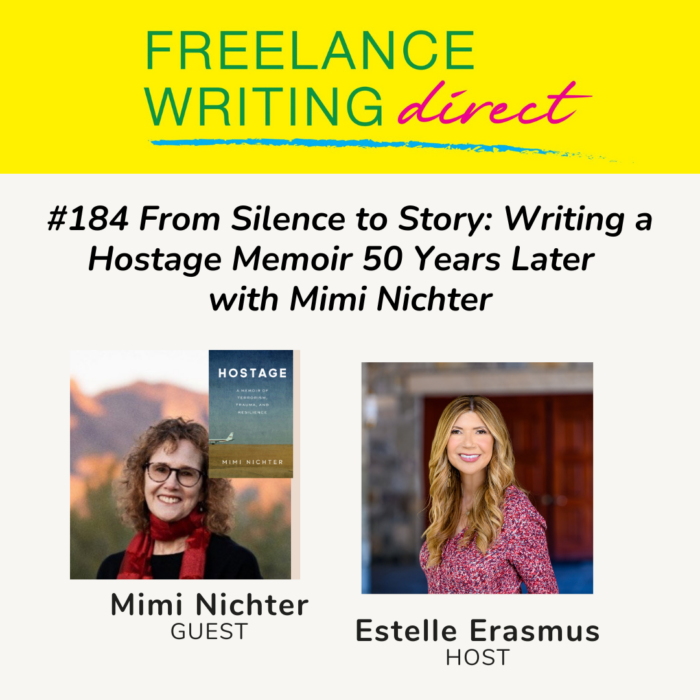
What does it take to write about a life-altering trauma five decades after it happened?
In this episode, I chat with Mimi Nichter about the long arc from lived experience to the page, and what it means to revisit a moment of crisis with clarity. We talk about writing through memory, shaping a narrative around a defining event, and the emotional and craft challenges of telling a story that has festered inside for years, waiting to be heard.
Mimi shares how she approached writing about being held hostage, why timing mattered, and how she transformed silence into story.
In This Episode
- Writing about trauma years later
- How distance shapes perspective on the page
- Structuring a memoir around a central event
- Balancing emotional truth with narrative control
- What writers need to consider when revisiting difficult experiences
Watch on YouTube
Don’t miss episode #183 Don’t Give Up on Ghostwriting. What Pays and What’s Still Dead
And find the free resource guide from the panel I moderated there here.
About Mimi
Mimi Nichter is an award-winning cultural anthropologist who studies core concerns in contemporary American society and global public health. She is a professor emerita of anthropology at the University of Arizona. Dr. Nichter is the author or coauthor of four anthropology-related books and the recipient of the Margaret Mead Award for writing that reaches a wide public audience. Her memoir, Hostage, was selected as a finalist for the Literary Award in Non-Fiction at the Tucson Festival of Books. Her essays have appeared in Newsweek, HuffPost, and Brevity.
Connect with Mimi
From Classroom to Publication
One of my former NYU students, Molly Williams, just published a powerful essay in The Cut: Search and Rescue and Me
She began this essay in my NYU class and continued developing it in my Zoom workshop, where it took shape before she brought it to its final form.
What I love about this piece is how it immediately pulls us into the action. There are real stakes, urgency, and a vivid sense of place. But what makes it publishable is what happens beneath that surface. The essay deepens into a story about identity, motherhood, and the meaning we make from experience. And those are the best kinds of essays because even if the experiences are different, we can still see ourselves in them.
Get More From Estelle Erasmus
- Free NYU “Editor on Call” Event
Join Estelle Erasmus and the editor-in-chief of PROVOKED on April 22 from 12:30–1:30 PM EDT to learn how to pitch and publish your work.
Register here: - Private Small-Group Memoir/Essay Class
My Next 6-week session is in September/October 2026. May is Sold Out.
Email freelancewritingdirect@gmail.com for details. - Read & Subscribe
Substack: NEW POST — Why Your Memoir Draft Still Feels Flat (And How to Fix It) - Newsletter
Sign up at estelleserasmus.com for show updates and a free Pitching Guide. - Watch
Estelle’s TEDx Talk: How to Get Noticed in Your Writing and Beyond - Book
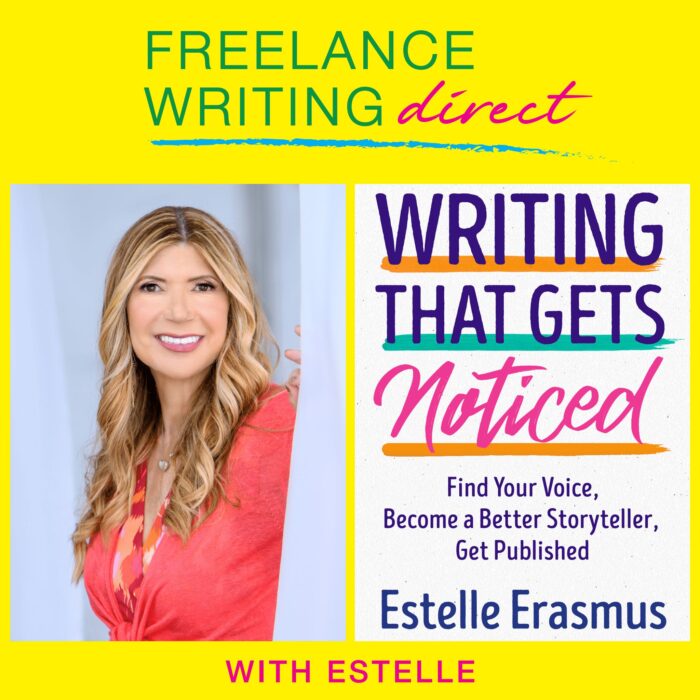
Writing That Gets Noticed — named a Poets & Writers “Best Book for Writers.” - Listen/Watch
Freelance Writing Direct Podcast — 2026 and 2025 Podcast of the Year (American Writing Awards)
About Estelle
Estelle Erasmus is an award-winning journalist, TEDx speaker, and author of Writing That Gets Noticed. She is the host, founder, and executive producer of Freelance Writing Direct and an adjunct professor at NYU.
Her work has appeared in more than 150 publications, including The New York Times, The Washington Post, WIRED, PBS/Next Avenue, The Independent, and AARP The Magazine. She has served as editor-in-chief of five national magazines.
Follow Estelle
Instagram: @EstelleSErasmus
TikTok: @EstelleSErasmus
Twitter/X: @EstelleSErasmus
Bluesky: @estelleserasmus.bsky.social